Penang Puppet Festival 2026 檳城偶戲節 2026

BERBUNGA | 生花

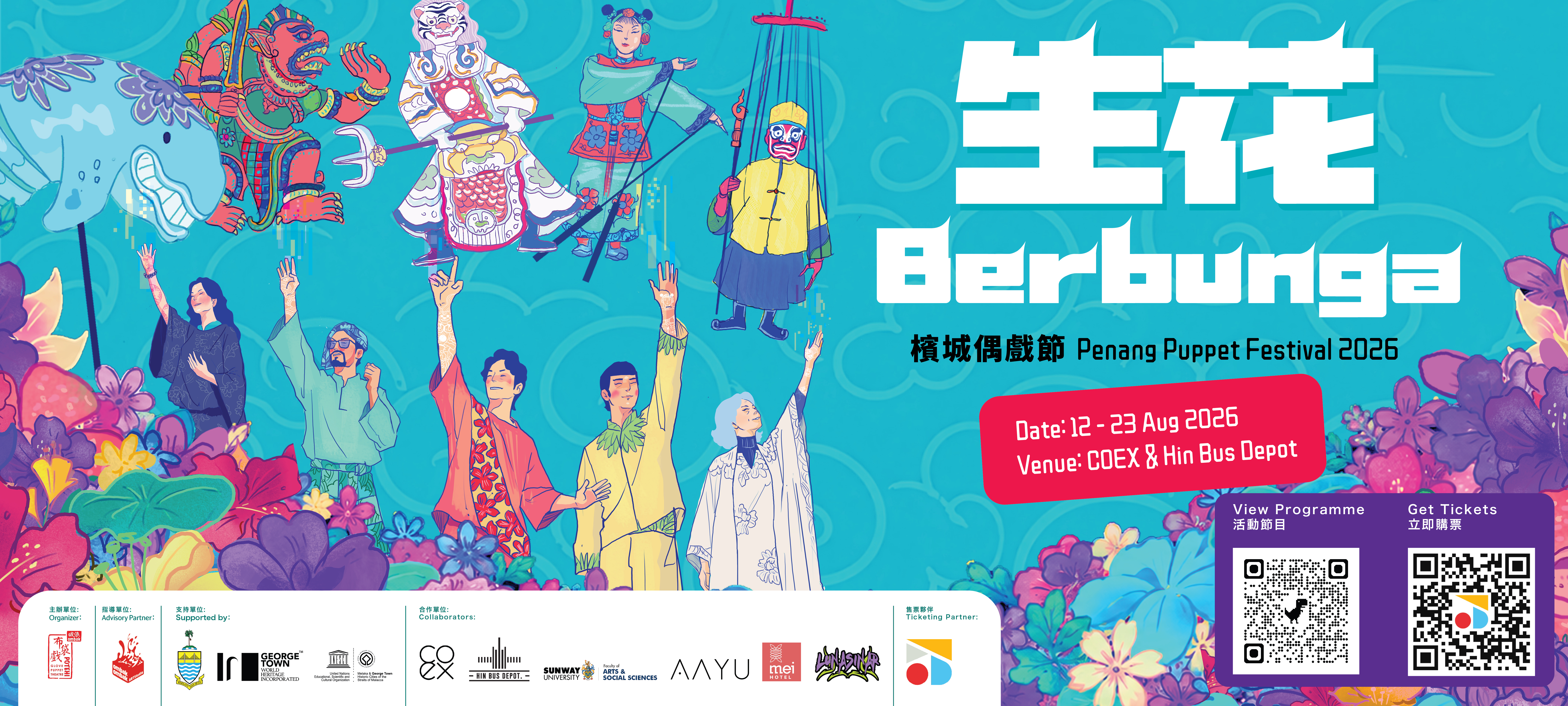
Penang Puppet Festival (PPF) returns from 12–23 August 2026 with its third edition, BERBUNGA (生花), celebrating puppetry as a living tradition that continues to grow, adapt and inspire across generations.

The festival opens with a historic gathering of representatives from five regions where Hokkien glove puppetry (POTEHI) continues to flourish—Penang, Jakarta, Singapore, Taipei and Zhangzhou (Fujian)—marking the first time these living traditions come together in Southeast Asia.

Over 12 days, audiences can experience performances, exhibitions, artist talks, workshops, forums and community programmes featuring diverse forms of puppetry, including POTEHI, Teochew iron-rod puppetry, Wayang Kulit Kelantan, contemporary puppetry and shadow theatre.

More than a celebration of performance, PPF 2026 creates a platform for intercultural dialogue, artistic exchange and heritage transmission, inviting audiences to discover how traditional puppetry continues to bloom in the contemporary world.

檳城偶戲節(Penang Puppet Festival, PPF)將於 2026 年 8 月 12 至 23 日舉行,以 「生花 BERBUNGA」 為主題,透過演出、交流與創作,展現偶戲作為活態文化,如何在不同土地持續生長、傳承與創新。

本屆偶戲節將迎來東南亞首次——來自檳城、雅加達、新加坡、臺北及福建漳州五個仍延續閩南布袋戲(POTEHI)傳承的地區代表齊聚檳城,共同呈現同源文化在不同社會與歷史脈絡下所發展出的多元風貌。

十二天的節目涵蓋布袋戲、潮州鐵枝木偶、吉蘭丹皮影戲、當代偶戲及影子戲等多元偶戲形式,並設有展覽、講座、工作坊、論壇及社區活動,打造一個連結藝術、文化、教育與國際交流的平台,讓傳統偶戲在當代持續綻放新的生命力。

Photos
Videos

PROJECT DETAILS

Date & Time

TICKETS

Category

Venue

DURATION

OTHER FASCINATING PROGRAMMES

Solo exhibition by Tao G. Vrhovec Sambolec Involuntary Writing by Amsterdam-based artist Tao G. Vrhovec Sambolec is presented at Blank Canvas that brings together site-specific murals and a triptych consisting of a digital scan, a black and white photograph, and a rubber stamp imprint. The project highlights unintentional ink stains that occur while writing by hand. The artist turns attention to these unintended marks, treating them as visual forms in their own right, which are magnified and reworked within the exhibition space. He foregrounds their idiosyncratic, irregular shapes as visual elements that are neither illustrations, symbolic representations, nor abstractions, but incomprehensible forms that, nevertheless, radiate familiarity. Rather than trying to define or interpret them, the project leans into this ambiguity by adopting a non-interpretative gaze – one that is more akin to “listening to shapes”, allowing their presence to be felt rather than explained.
“My body is a headless train. My body is a legless boat.” Premiered in 2025 to critical acclaim, the award-nominated “Lament of the Wandering Head” by Sun Son Theatre is a haunting, female-led performance that blends live music, physical theatre, and storytelling. Inspired by the flying head spirit of Southeast Asian folklore, the work reimagines myth as a powerful reflection on migration, displacement, and the fractured histories of the Chinese diaspora. Performed in Mandarin and Penang Hokkien, the production creates a rare bilingual soundscape where language, movement, and music intertwine. Combining traditional Taiwanese percussion with Southeast Asian gongs, chanting, and ritual rhythms, “Lament of the Wandering Head” invites audiences into a visceral theatrical journey where the body speaks as powerfully as words.
Cultprint, Penang hosts “The Natural History Museum of Yeahnahnesia”, presented by artist duo Yok & Sheryo, curated by Deborah Lim, and realised in collaboration with SPUTNIKFOREST. The museum brings together a collection of rare artefacts, specimens and cultural objects—many exhibited publicly for the first time—offering an introduction to the island nation of Yeahnahnesia. Entrusted to the artists by the island’s guardians, these objects reveal its natural history, rituals and traditions, offering insight into a civilisation shaped by balance, playfulness and unhurried living. Visitors are invited to explore the museum’s collections through paintings, sculpture, installation and environmental design, encountering endemic species, ceremonial objects and enduring traditions that reveal the histories, beliefs and material culture of Yeahnahnesia. Through these collections, the museum invites audiences to reflect on the values that have shaped the island for generations—and to imagine what it might mean to embrace the Yeahnahnesian way of life.